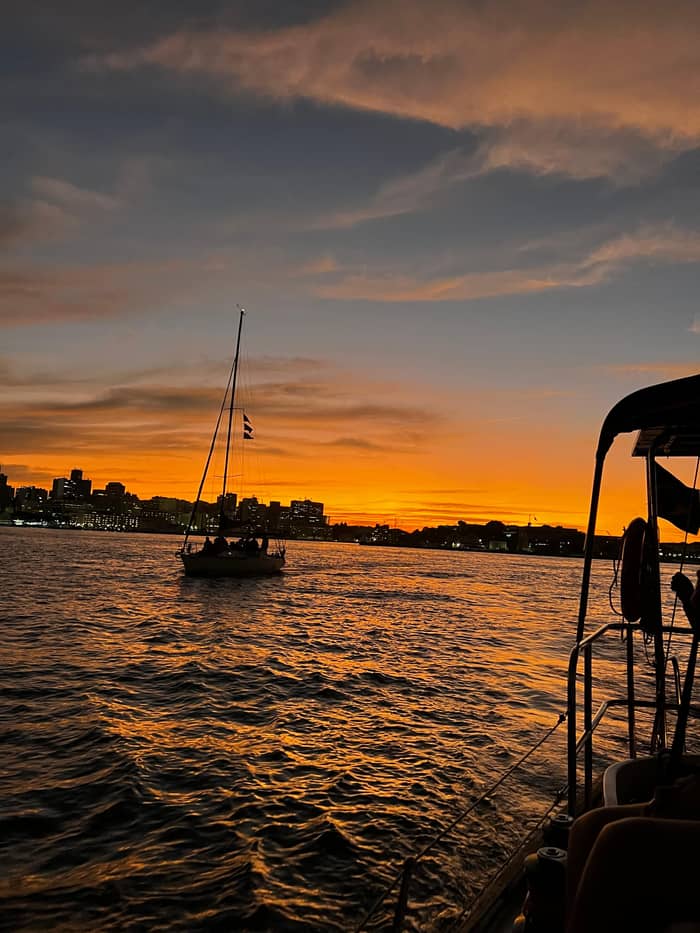
Warm, stormy
Summer
December to February
Check sail datesGuides
Language
Currency
Check datesfrom $57 · cancel for freeYour own checklist
Answer in brief
Yes, you can sail in the rain on Guanabara Bay: a shower rarely stops the trip, but wind and sea can, and the captain makes the call; summer rain usually comes as short afternoon showers.
Safety first
Checklist: 10 items
Tap to check items off; your progress is remembered on this device.
0 / 10 ready
All done. All that is left is to pick the evening you want on the water.
Book a seatCan you sail in the rain on Guanabara Bay? Usually a shower is not the problem; wind and sea are. Here is how Rio's seasons, the Navy's rules and the crew decide your evening.
Editorial team, riosunsetsail.com · Updated November 11, 2026 · Read in 8 min
The essentials
Can you sail in the rain? On Guanabara Bay the honest answer is that rain alone rarely decides it. According to the sunset sail's listing, the captain may alter the route when conditions demand it, and the swim can be skipped if wind, current or rain make it unwise. In other words, a light shower changes the details of the evening, while wind and sea decide whether the boat leaves the marina at all.
Other operators on the bay say the same thing in their own terms. One night boat party on a 2-story boat goes ahead in rain, but its listing notes that the Navy cancels it in bad weather. A short catamaran circuit runs only in good weather, and when the crew calls it off, guests can rebook or take a refund. The pattern is consistent: drizzle is part of a tropical evening, but a storm is not something any crew takes guests into.
For you, that leads to a simple plan with very little risk. Book a sail that stays refundable until the eve of departure, as the sunset sail does, and keep an eye on the outlook as the date nears. If the evening looks wet but calm, go: the light after a shower is often beautiful. If the crew postpones for wind, take the offered alternative date or the refund rather than pushing for a rough trip.
The year at a glance
| Months | High °C | Low °C | Rain |
|---|---|---|---|
| December to February | 30.3 to 32.212 | 23.2 to 24.413 | Wet season10 |
| March to May | 27.8 to 31.212 | 20.7 to 2413 | Showers, fewer14 |
| June to August | 26.4 to 2712 | 18.7 to 19.313 | Dry season11 |
| September to November | 26.7 to 29.412 | 19.6 to 22.313 | Rains return |
Temperatures: INMET normal 1981 to 2010, Rio de Janeiro station 83743; seasons from Riotur and Alerta Rio.12,13,10,11
Most of the time it does not. The municipal forecasters at Alerta Rio say summer can bring short, heavy showers, mainly in the afternoon.1 A classic hot day, in their words, brings rising heat and clear skies, then showers in the afternoon and evening.5 So when people ask whether it rains all day in Rio de Janeiro, the usual summer answer is a bright morning and a shower later in the day.
There are exceptions. The same service explains that the South Atlantic Convergence Zone, a channel of moisture from the Amazon, can bring cloud and rain for at least 4 days in a row.6 Wet months can be relentless: in February 2023 it rained on 22 of the 28 days.7 On those stretches a dry evening window may simply not come, and a flexible plan with a spare evening is the sensible plan.
Rainfall adds up in the warm months. Alerta Rio puts the average summer total since 1997 at 432.6 mm, and the long-term average for February alone at 120.4 mm.8,9 For the tourism authority Riotur, the rainy, humid stretch runs from December to March, and the drier, fresher one from June to September.10,11 Pick your season with that in mind, and pack a light rain shell between December and March.
Daytime highs
INMET climate normal 1981 to 2010, station 83743 Rio de Janeiro; mean daily maximum by month.12
Rio is warm all year, but the difference between seasons is real on a boat in the evening. INMET, Brazil's national weather institute, gives a mean maximum of 31.5 °C in January and 26.4 °C in July for its Rio de Janeiro station over 1981 to 2010.12 Mean minimums run from 24.1 °C in January down to 18.7 °C in July.13 A sunset sail sits between those numbers, as the day cools toward the night's low.
In summer that means a warm deck and warm air even after dark; a light shirt is enough and the breeze is welcome. In winter the evenings are noticeably fresher, and once the sun has gone and the boat is moving, a thin layer makes the return leg much more comfortable. The chart and the table here set out the INMET averages for each part of the year, so you can see the swing before you pack.
These are city station averages, not readings from the middle of the bay. On the water the wind adds a chill that a thermometer on land does not record, and a passing shower can drop the feel of the air quickly. If you get cold easily, bring a windproof layer in any month, and in winter add a light sweater. You can always take it off; you cannot borrow one halfway across the bay.
What if...
Find your situation and the sensible move.
If The forecast shows a summer shower
Go, keep a layer handy
Summer showers tend to be short and fall mainly in the afternoon.1
If A cold front is due on my date
Move the sail
You can still cancel at no cost a day ahead.
If I want a guaranteed swim
Do not count on it
The swim stop depends on wind, currents and rain.
If I get seasick easily
Take your remedy early
Medication works best before the motion starts.16
If I want to be on the water after dark
Book a night trip
Boat parties run at sunset or at night.
Seasons on deck
Warm, stormy
December to February
Check sail dates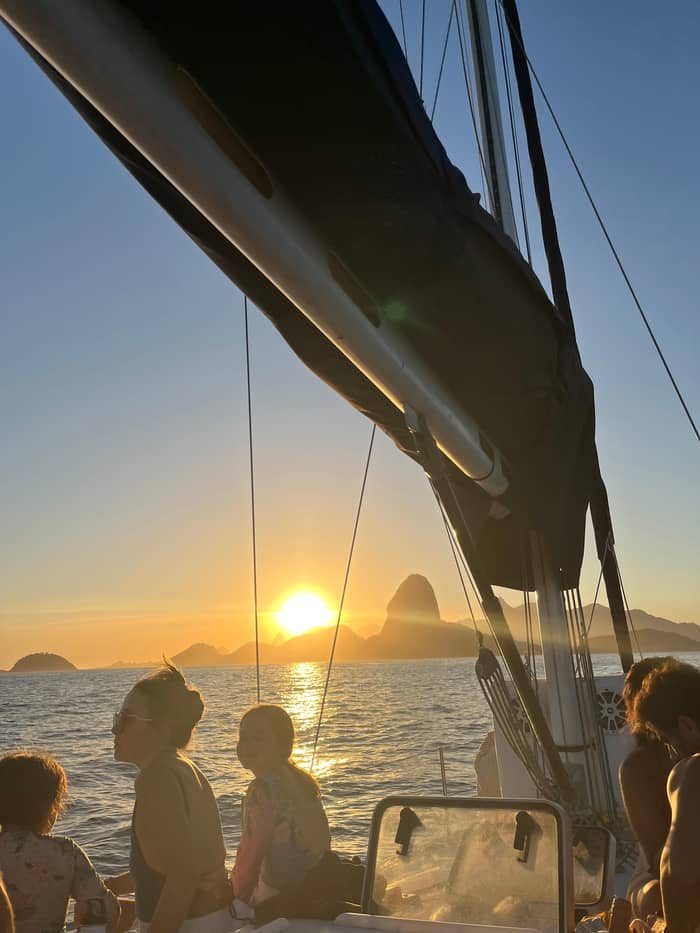
Fronts arrive
March to May
Check sail dates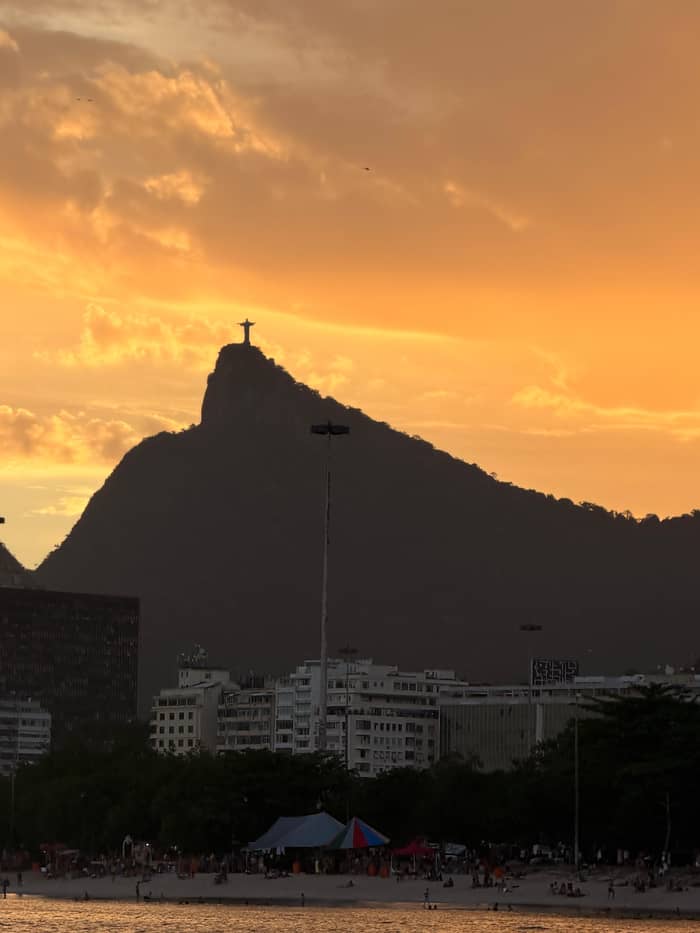
Dry, cooler
June to August
Check sail datesWind is the real gatekeeper. Brazil's Navy, through the Rio de Janeiro harbor master, defines the water inside Guanabara Bay as Inner Area 1, bounded by the bay mouth between Ponta de Santa Cruz and Ponta de São João.21 The sunset sail's route stays near that mouth, turning at the Santa Cruz fortress and Boa Viagem Island, so most of the evening is spent inside sheltered water rather than on the open sea.
Outside the bay the rules tighten. The harbor master's standing orders let passenger boats, schooners and saveiros into Inner Area 2, the coastal water outside the bay, only with wind up to 10 knots, a slight swell of 30 cm and no forecast of worsening weather.2 Recreational and inland boats are limited there to wind up to 15 knots and waves up to 1.5 m.22 Those limits explain why an ocean leg can be cut while the bay trip goes ahead.
The season matters too. Alerta Rio notes that the number of cold fronts rises in autumn, especially toward June.4 A front brings a shift in wind, cooler air and often a day or so of rough water at the bay mouth. Autumn mornings also see more mist and fog.15 If your trip falls in that season, keep a spare evening free so you can move the sail if a front arrives on your chosen date.
Plan around the weather
Choose a trip, then the number of travelers.
Review 4 options
Choose a trip, then the number of travelers.
≈
View≈
View≈
View≈
ViewAll amounts are from-prices on GetYourGuide, converted at the ECB reference rate. Exact prices are shown at booking.
If the sky looks doubtful
Days before
Fronts come more often toward June.4
A day before
Cancel free up to 24 hours ahead.
On the day
Summer showers tend to fall after lunch.1
At the marina
Be at the gate 15 minutes early.
Before leaving
The skipper explains the life jackets.3
On the water
Route and swim depend on wind and sea.
Every passenger boat on the bay works under the harbor master's rules. They require boats carrying passengers to display instructions on the correct use of life jackets, and the skipper must show passengers how to use them before casting off.3 Boats supporting tourism must also post the maximum number of passengers, where the life jackets are kept, the permitted capacity and the emergency exits.18 Read the poster when you board.
Life jackets matter whatever your swimming ability. The CDC, the United States public health agency, says they lower the danger of drowning on a boat for young and old alike, strong swimmers included, and that children should wear them in and around natural water.23,17 If you are traveling with children, ask for child-size jackets at the briefing and fit them before the boat leaves the marina.
The swim stop near the Santa Cruz fortress is optional, depends on weather and sea and is never guaranteed. That agency also warns against drinking before or during a swim or a boat trip, since alcohol dulls judgment and coordination.19 If you plan to swim, save the caipirinha for the ride home. Non-swimmers can simply stay aboard; the view from the deck is the same. Ask the crew about entry and exit from the water before you jump.
Video
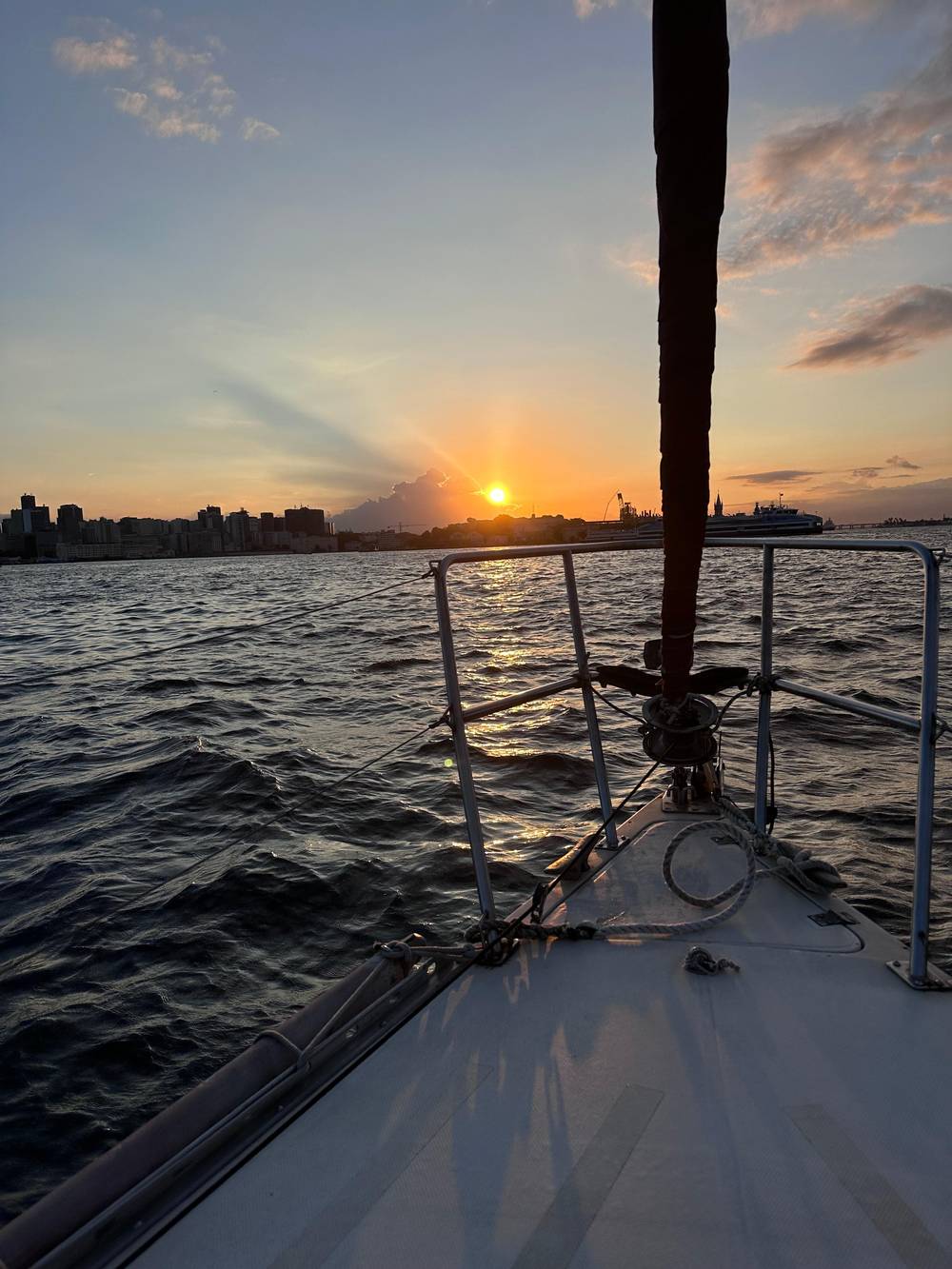
Tripster Panda on YouTube · The video only starts loading on your tap.
In this season there can be short, intense showers, mainly in the afternoon, the so-called summer rains.
Guanabara Bay is not the open ocean, and most of the sail stays in the sheltered Inner Area 1.21 Even so, the swell at the bay mouth can roll a small boat, and sensitive stomachs notice it. The CDC points out that the very word nausea comes from the Greek naus, meaning ship, which says a lot about how old this problem is.24 The good news is that a few simple habits help a great deal on a short evening sail.
The same advice works on any boat. The CDC recommends looking at the horizon and avoiding visual tasks such as reading, because that reduces the mismatch between what the eyes and the inner ear report.20 It adds that standing with the motion of the boat, getting your sea legs, helps, and that alcohol and smoking make motion sickness worse.25,26 On a sunset sail, the horizon is the whole point anyway.
If you know you get seasick, take your usual remedy before you board; the CDC advises that tablets help most when swallowed ahead of the trip, not once you already feel unwell.16 Choose a seat close to the center of the deck, which pitches less, keep some fresh air on your face and nibble the snacks rather than skipping them. Tell the crew early: they have seen it before and can find you a steadier spot.
Yes, you can, and there are several ways to do it on the bay. The sunset sail itself ends after dark in many months, since civil twilight in mid-January lasts until about 7:08 PM and the boat is often still on the water.27 Rio also has trips built for the night: a boat party of 4 hours sails at sunset or as a night party with a DJ, and another night party runs on a 2-story boat for 150 guests.
Not every vessel may sail after dark, though. The harbor master's rules allow jet skis in the coastal waters outside the bay only by day, with traffic between sunset and sunrise forbidden.28 Boats are also barred from anchoring, mooring or lingering near the pillars of the Rio-Niterói Bridge.29 Licensed passenger boats with lights and crews are a different matter, and the lit skyline from the water is one of the city's great sights.
If you want to sail at night, choose a trip that is built for it rather than asking a day boat to stay out late. Check whether the boat is accessible before booking; one night party listing, for example, says it is not wheelchair accessible. Keep your phone and documents in a sealed pocket, wear shoes that grip a wet deck and follow the crew's instructions when boarding in the dark.
FAQ
Rain can cancel the swim stop, and the captain may change the route for the weather.
If you call it off yourself, the sunset sail refunds you in full up to the day before.
The skipper must explain life jackets to passengers before casting off.3
Most of the sail stays in the bay's sheltered inner waters.21
Night boat parties sail on the bay; jet skis outside the bay may not.28
Riotur calls it the dry season, with cooler weather and little rain.11
Sources
Planning a sail on the bay? Ask a real person.